During online Nationals registration, Studios must nominate themselves and select their 12 routines for The OPUS Award consideration.
There is no additional fee to enter, aside from standard Finals Competition fees.
Studios that have earned the OPUS Award must observe a two-year waiting period before becoming eligible to compete for the title again. For example, a studio awarded in 2026 would next be eligible in the 2029 season. This policy is designed to celebrate a diverse range of studios and ensure new voices and visions have the opportunity to be recognized on the national stage.
Studios may compete in only one OPUS location: Las Vegas or Orlando.
Finals Competition
Routine Requirements
All nominated routines must be categorized as a Small Group, Large Group, Line, or Extended Line. Solo and Duo/Trio routines are not eligible.
Studios may adjust their 12 nominated routines up until 7 days prior to the event.
The OPUS Award values style integrity. Routines must be registered in their correct performance division. Misclassified routines may incur penalties or disqualification at the discretion of the Event Directors.
Ballet entries must be performed in ballet or pointe shoes.
“Aging up” a nominated routine is not permitted.
Dancer Eligibility
Eligible dancers must be ages 5–19 and have trained consistently at the studio for at least 8 months prior to Nationals.
Dancers must also have pre-qualified by competing in a group routine at one regional Press Play or RYZE event during the 2026–2027 season.
Dancers with professional experience are eligible only if they continue to train consistently at the studio.
Any eligibility concerns will be resolved at the discretion of the Event Directors.
Choreography Restrictions
A maximum of 4 out of the 12 nominated routines may be choreographed by an outside choreographer.
An outside choreographer is defined as someone who does not teach regular, in-person classes at the studio.
A choreographer is considered an in-house faculty member only if they teach at least twice per month, with a minimum of one week between classes, for 8 consecutive months leading up to Nationals. Virtual or Zoom instruction does not meet this requirement. The Event Directors reserve the right to make final decisions on any ambiguity related to this rule.
Time Limits, Set-up and Strike time
All OPUS Award-nominated routines must not exceed the applicable time limit by more than 1 additional minute, including routines that have been approved for extended time.
Small Groups: 3-minute time limit; maximum routine length of 4 minutes
Large Groups & Lines: 4-minute time limit; maximum routine length of 5 minutes
Extended Lines: 5-minute time limit; maximum routine length of 6 minutes
Routines that go over will be penalized 1 point for every 30 seconds (or portion thereof) beyond the limit. For example: 1–30 seconds over = 1 point deduction, 31–60 seconds over = 2 points, 61–90 seconds over = 3 points, etc.
For routines using props, set-up and removal must be completed within a total of 5 minutes. To clarify: this is a combined time limit—not 5 minutes for set-up and 5 minutes for removal. A 1-point deduction will be applied for any routine over the limit.
Classroom Audition
All dancers performing in one of a studio's 12 nominated OPUS Award routines are required to participate in the Classroom Audition.
Absences are permitted only in the case of an emergency and must receive prior approval from the Event Directors.
Studio Owners and Teachers are welcome to attend and observe the Classroom Auditions.
OPUS Classroom Audition Attire is at the discretion of the studio owner.
OPUS dancers need to wear their OPUS Nationals scholarship number for the audition.
Studios may not coach or rehearse dancers in the audition. Dancers may rehearse on their own.
The Match-Up at The OPUS Award Dance-Off
Dancers cannot be switched from the Finals Competition to the Match-Up.
In the event of an emergency, replacement dancers may be approved at the sole discretion of the Event Directors.
Studio Dance-Off order
Immediately following the announcement of the Top 10 Studios advancing to the OPUS Classroom Auditions, a representative from each qualifying studio will meet backstage to determine the audition order.
At random, each studio will draw a number. The number drawn will determine that studio's order for all Mini, Junior, Teen, and Senior Classroom Auditions. For example, if Studio A draws #3, it will audition third in each Classroom Audition.
For the Top 5 Dance-Off Round, the audition order will be reversed based on the original draw. For example, if Studios A (#3), C (#4), D (#6), F (#9), and H (#10) advance to the Dance-Off, they will compete in the following order: #10, #9, #6, #4, and #3.
The Top 5 Studios that re-compete their 12 OPUS-nominated routines will do so in this order:
1. Mini/Junior Ballet
2. Teen/Senior Ballet
3. Mini/Junior Jazz
4. Teen/Senior Jazz
5. Mini/Junior Tap
6. Teen/Senior Tap
7. Mini/Junior Contemp. or Lyrical
8. Teen/Senior Contemp. or Lyrical
9. Mini/Junior Mus. Theatre or Ballroom
10. Teen/Senior Mus. Theatre or Ballroom
11. Mini/Junior Hip-Hop
12. Teen/Senior Hip-Hop
Mini/Junior Ballet
Teen/Senior Ballet
Mini/Junior Jazz
Teen/Senior Jazz
Mini/Junior Tap
Teen/Senior Tap
Mini/Junior Contemporary or Lyrical
Teen/Senior Contemporary or Lyrical
Mini/Junior Musical Theatre or Ballroom
Teen/Senior Musical Theatre or Ballroom
Mini/Junior Hip-Hop
Teen/Senior Hip-Hop
The OPUS Award Prize Distribution & Guidelines
The maximum total cash prizes awarded per studio is $5,000, and the maximum total value of OPUS vouchers awarded per studio is $5,000. These limits supersede all other group-based cash prizes and voucher awards.
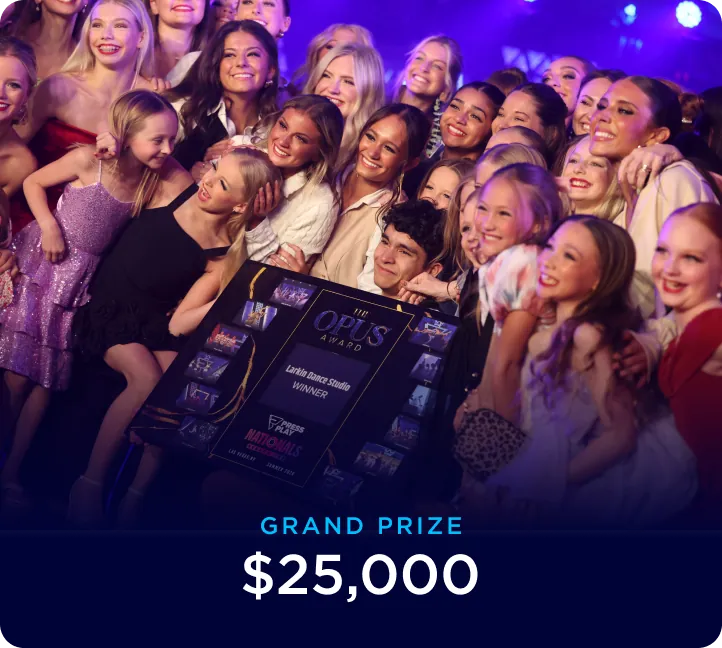
The studio receiving the $25,000 OPUS Award is excluded from these limits and will receive the $25,000 cash award only. That studio will not receive any additional group-based cash prizes or OPUS vouchers.
Any individual cash prizes are not affected by these limits and will be awarded in full.
Discretion of Event Directors
The OPUS Award is designed to recognize not only artistic excellence, but also integrity, dedication, and consistency within the studio community. Our rules and policies have been thoughtfully developed to uphold the spirit and fairness of the competition.
All questions, disputes, and rule clarifications will be reviewed and resolved solely at the discretion of the Event Directors, whose decisions are final.
We are deeply committed to ensuring that The OPUS Award is a prestigious and rewarding experience for every participating studio.